Piping· Release 2.68
Piping design software for line lists, wall thickness and surge.
The Piping Design Bench works from a line list — one row per line with fluid, service, pipe and installation — to Darcy–Weisbach hydraulics, ASME B31.3 wall thickness and branch reinforcement, pumps and NPSH, and surge by the method of characteristics. Every line carries its review code.
From the line list to the surge case.
Concept, detailed design and design verification run on the same engines, so the hydraulics and the review never disagree.
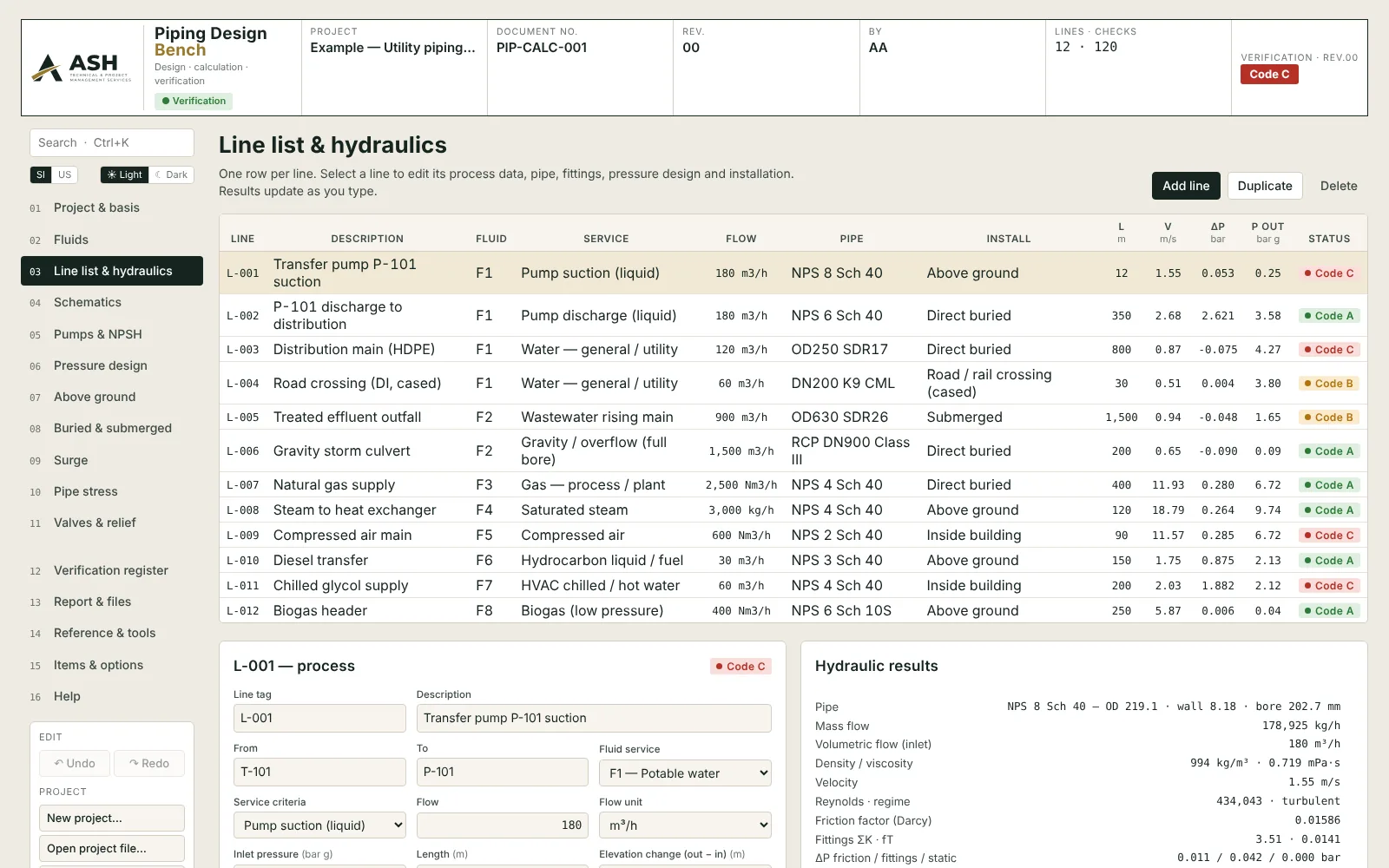
Line list & hydraulics
One row per line: fluid, service, pipe and installation; Darcy–Weisbach results and the review code per line.
Wall thickness & reinforcement
ASME B31.3 wall thickness and branch reinforcement.
Pumps, supports & expansion
Pumps and NPSH; supports and expansion.
Buried & submerged pipe
Buried and submerged pipe.
Networks & fire flow
Looped networks with EPANET exchange; fire flow; extended-period simulation.
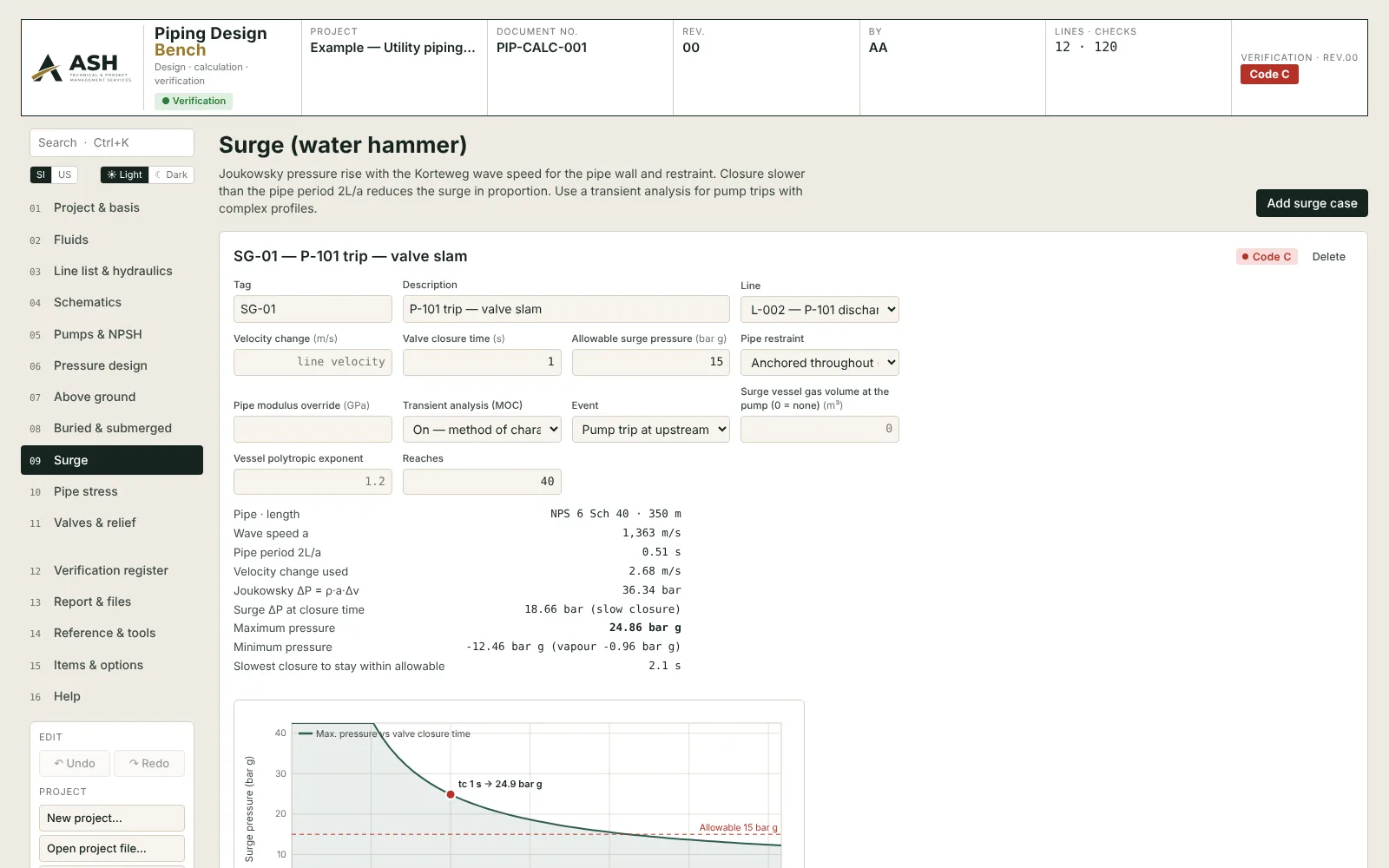
Surge (water hammer)
Surge by the method of characteristics: Joukowsky and transient cases per line — wave speed, pipe period, maximum and minimum pressures against the allowable.
Line list, hydraulics and surge.
Screens from the example project that ships with the Piping Design Bench.
Concept, detailed design, verification — the same engines throughout.
A concept scheme, the detailed design and the reviewer's check are run by the same code, so they never disagree with each other. Choose the stage when a project starts; develop a concept into the detailed design in one click.
From a few inputs to a sized scheme
- Floor areas, occupancy, grid, flows, population
- Plant sizes, member sizes, main feeders, storage, quantities
- For options, budgets and early coordination
Every element, every check
- Element-by-element sizing with code checks and clause references
- Diagrams, schedules, single-line and riser diagrams, SVG export
- Calculation report for submission; Excel and CSV schedules
Independent check of a design by others
- Submitted values beside the calculated ones
- Review codes A / B / C with the clause; CRS comment rows
- Rev.xx resubmission cycles; value-engineering opportunities
Which codes and standards do the benches use?
The Saudi Building Code set (SBC 201, 301, 304 and 801) and the Saudi Civil Defence regulations, ACI 318 and ASCE 7, AISC 360-22, the International Codes (IBC, IPC, IMC, IFC), NFPA 13, 14, 20, 72, 92, 101 and 2001, NEC and IEC 60364 / 60909 for electrical, IEEE 1584 for arc flash, ASHRAE Fundamentals for HVAC, ASME B31.3, API 520, ISO 5167 and IEC 61511 for piping and instruments, IEC 62676-4 for CCTV, and QCS 2014 with the Qatar Civil Defence guidelines among others. Every check names its clause, and each requirement pack states the edition it quotes.
Can I bring in the contractor's schedules?
Yes. Import data in any bench reads Excel, CSV, pasted tables and DXF; the Data Import tool also reads schedules from text PDFs and traces single-line diagrams. Cable and instrument schedules can be checked line by line against the calculation.
Is my project data sent anywhere?
Your project never leaves your computer: the benches and ELDAS keep projects in the browser and in the files you save. The pages serve their own fonts; the trial applications still load their web fonts from Google Fonts. See the privacy notice.
Try the Piping Design Bench for 30 days.
[email protected]The trial builds are time-limited, open at the design-review stage and watermark their reports. For a walk-through on a package of yours, or the full version: which bench, whether you design or review, and how many people would use it — we reply within one business day. Pricing is published after the company registration completes.